

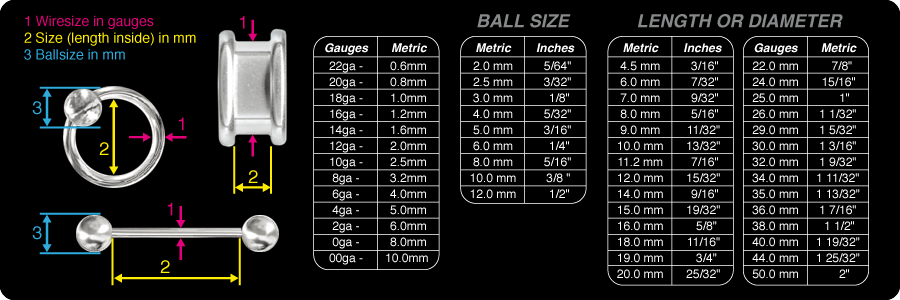
This is the bar size (thickness) in most jewelry pieces. Basically, it is the thickness of the body piercing where the jewelry is inserted.
Types:
0.8 mm and 1 mm are mainly used for nose and earlobe piercings.
1.2 mm is used for eyebrow, lip, and ear cartilage.
1.6 mm is the most common size for tongue and navel piercings.
Thicker gauges are used to enlarge piercings. This is a gradual process.
Piercings are measured by thickness and length.
Hoop piercings are measured by inner diameter.
The bar has a hollow tube inside and the ball has a very thin slightly curved pin. First, the pin is inserted halfway into the tube; then it is bent slightly more so it curves further, and the piece is fully pushed in.
The curvature creates friction inside the tube, preventing the piece from falling out.
An alternative to hinged hoops, this is the most comfortable system for closed jewelry. It is essential in both plain and decorative rings.
A segment of the hoop is attached via a hinge on one side, while the other side has a tab that clicks into place. This allows easy opening and secure closing.
Once closed, the hoop is completely smooth with no visible break.
Balls are replaceable depending on size, but normally 3 mm and 4 mm are used for eyebrow and lip. 5 mm and 6 mm are used for tongue piercings. The navel usually uses 8 mm on the bottom ball and 5 mm on the top, although 6 mm and 4 mm balls can also be found.
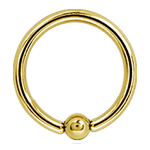
The BCR is a popular piercing piece. It is comfortable, easy to wear, and easy to replace by simply sliding the ball. This ring is very popular because it is secure against hair or clothing snags and easy to heal.
It is a design that holds the ball very firmly in place and can be made of surgical steel or titanium.
The ball used in these models is called a “dimple,” and we offer various styles and models.
It can be used in almost all parts of the body.
We offer a wide range of sizes and styles.
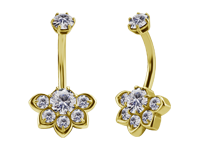
It is the oldest piercing model, the most commonly used models are the navel (belly button piercing), and they are even used as earrings for the ears.
The banana models for belly button piercings have a standard size of 1.6mm or 14 gauge. The ball on the upper part is mostly 5mm and the one on the lower part is 8mm. The micro bananas of 1.2mm or 16 gauges are used for the eyebrows.
The bananas will be available in surgical steel, titanium, and bioplast tm with a wide variety of designs. We have a large and exclusive selection of these pieces with sterling silver.
You can find them with crystals, with decorations, with colors, in many materials, hanging, large, small, and of course, the simplicity of classic balls.
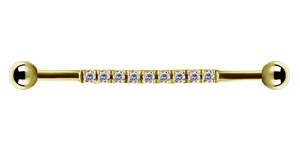
Barbells are easy to adapt to any area due to the wide range of sizes available. The balls can also be replaced with decorative pieces such as colored balls, gemstones, opals, pearls, etc.
They are used for tongue, ears, and nipples, although with thicker gauges they can also be used for genital piercings such as the Prince Albert.
Available in surgical steel, titanium, and bioplast.
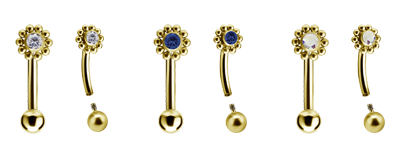
1.2 mm barbells, available in straight or curved versions. Mainly used for eyebrow and rook piercings.
The basic piece is very popular, but it can be combined with spikes, colored balls, or second-piercing designs from the catalog.
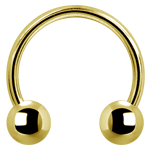
Circular barbells are versatile and used in all types of piercings. They are especially popular for septum piercings, as they can be hidden inward. They are also perfect for ears, nose, nipples, and genital piercings.
As with all our pieces, the basic balls can be replaced with more decorative ones.
Available in all materials and sizes.

Labrets serve the same function as barbells, but unlike them, they have a flat back that rests on the inside of the piercing for greater comfort.
Although there are many labret designs, they all share the same structure: flat base, bar, and thread (internal, external, or threadless). This is where decorative tops are placed. Once the correct size is chosen, the bar can be kept and the tops changed and combined freely.
We offer all types of labrets in different materials, mainly used for lips and especially ears.
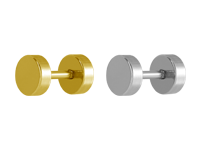
With 1.2 mm or 1.6 mm bars, these models simulate real stretching without going through the dilation process.
They are available in many materials and designs.
They also include two flat externally threaded discs for screwing and unscrewing.
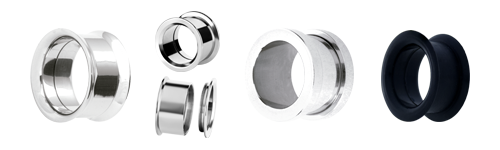
For us, a dilation is any piercing larger than 1.6 mm in thickness. Although most are used in ears, they can be done in other areas as well.
Even if not shown in the catalog, always ask for special sizes, as we offer up to 50 mm and many styles and colors.

We refer to nose studs or nose bones when talking about nostril jewelry. The most common model is the pigtail, available in all materials and many designs, from simple beads to more elaborate gemstone styles.
Recently, 1 mm or 0.8 mm labrets are also widely used for this piercing.

Nipple piercings can be horizontal, vertical, or at any angle. Although the initial piece is always a barbell, we offer many designs for second-stage jewelry.
The Nipple Shield is a model with a central bar; the areola is partially covered by the outer part of the jewelry, making it both aesthetic and versatile.
Some designs cover only the upper or lower part of the areola.
We also offer special barbells for this area.

We offer a wide variety of piercing accessories: balls, pearls, chains, charms, opals, zirconias, etc.
All in different materials: surgical steel, titanium, cobalt, 18k gold, etc.